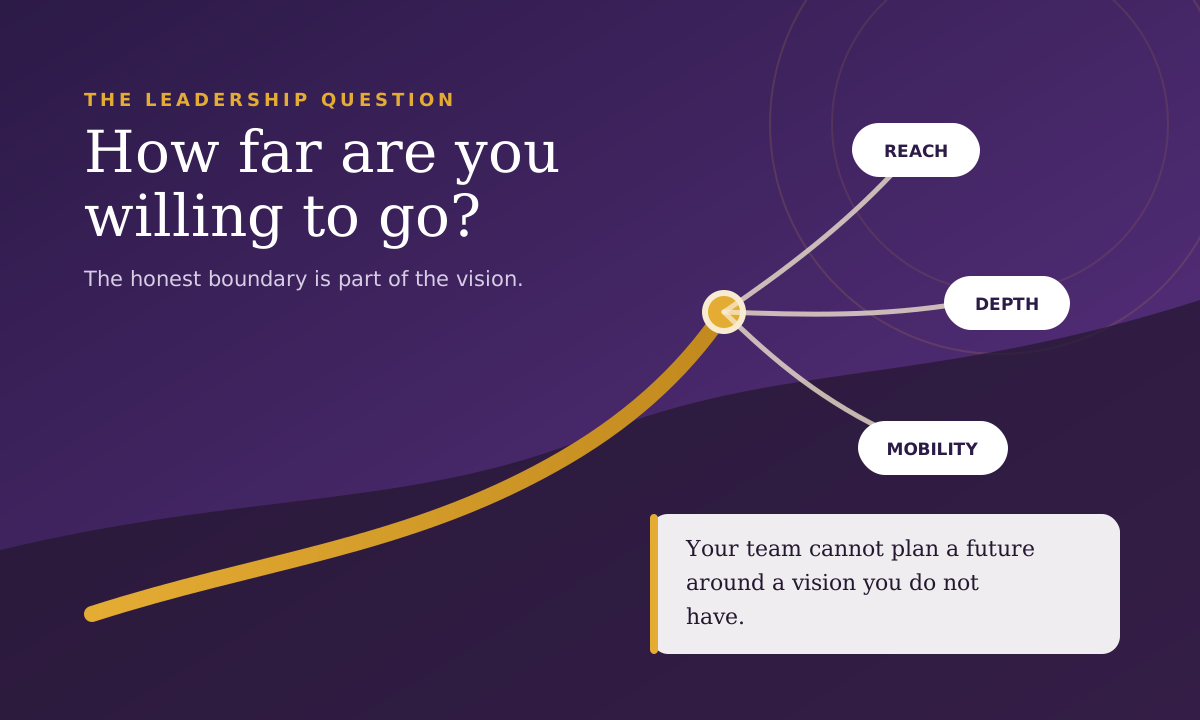
Before we ask whether an organization should grow, I think a leader has to answer a more basic question: How far are you actually willing to take it?
Not how far the market could take it. Not how large the board, funders, or staff might imagine it becoming. How far are you, as the person carrying the final responsibility, willing to go?
That question includes size, geography, revenue, team structure, management layers, risk, complexity, and how much authority you are prepared to release. It also includes the life you want. A founder may want a stable team and a manageable client load. A nonprofit executive director may want depth in one community rather than expansion into three more counties. A maternal health organization may decide that continuity of care matters more than volume.
Those are not failures of ambition. They are leadership choices. The problem begins when the leader has privately made that choice but the organization is still publicly promising growth.
Your team cannot plan a future around a vision you do not have. That does not mean your vision has to remain fixed forever. A useful vision grows as you learn, as the organization changes, and as your own capacity and appetite change. But it still has to be real enough to guide the choices you are making now.
We are systems within systems. A leader brings personal capacity, values, responsibilities, and limits into an organizational system that also operates inside funding, labor, community, and regulatory systems. None of those systems is static. They change because people make choices inside them. The point of vision is not to predict every future move. It is to make the current direction honest enough that other people can make choices too.
The question comes before the strategy
Growth is often treated as the obvious destination. Revenue should rise. The team should get bigger. The service area should expand. More programs should be added. But those are not neutral developments. Each one changes what the organization asks of its leader and its people.
As I wrote in Is Your Business Ready to Scale, demand tells you there is an opportunity, while the operation tells you whether it can carry the growth. There is another question underneath both: Does the leader actually want the organization that growth would create?
You may want the mission to travel farther without wanting to supervise a larger workforce. You may want stronger revenue without wanting a national footprint. You may want the organization to become more stable, more trusted, and better at its work without becoming bigger. Say that. A clear boundary is not a lack of vision. It is part of the vision.
Silence has a limit
Silence can be a useful executive strategy. A leader may need time to observe, gather evidence, consider risk, or avoid making a promise too early. Not every uncertainty needs an immediate announcement.
But silence stops being strategy when the decision is already clear and the leader is using silence to avoid naming it. If you know you do not want another location, a larger team, a new management layer, or a more complex organization, keeping that knowledge private does not preserve flexibility. It transfers the cost of your indecision to other people.
That is the same executive pattern I examine in You Cannot Onboard Around a Decision Leadership Refuses to Make. A decision leadership will not make, communicate, and uphold does not stay at the executive level. The ambiguity travels downstream.
Here, it travels into hiring, performance conversations, succession planning, compensation, and retention. Employees are left to interpret vague language about possibility while leadership benefits from the energy that possibility creates.
It is okay to say this far
Some leaders do not want expansion. Others want a specific kind of growth and not another. One founder may want a ten-person firm with deep expertise. One executive director may want one excellent maternal health program with reliable funding and no additional sites. Another may be willing to grow revenue but not add services that require a different clinical, compliance, or management model.
This far is a legitimate answer. So is not yet. So is I am willing to grow if these operating conditions are met. What is not legitimate is allowing everyone else to build plans around an answer you already know is no.
For nonprofits, this matters because doing more with less is not an operating model. Expansion does not make the underlying work disappear. It adds hiring, supervision, finance, reporting, handoffs, technology, and decision load. If you do not want to carry that operation, honesty is wiser than performing an appetite for growth you do not have.
Honesty is selfish and selfless
Being honest about your limit is selfish in the healthiest sense. It protects you from building a job, a schedule, and an organization you do not want. It allows you to define success without borrowing somebody else's definition of scale. It can protect the quality of the work, your own health, and the part of the mission you are actually prepared to steward.
It is also selfless. Your employees are making decisions about their lives. They are deciding whether to stay, whether to accept lower pay for future opportunity, whether to prepare for management, and whether to invest another two or three years in the organization. They deserve enough truth to decide whether your destination fits theirs.
A coordinator may absorb supervision because she believes a department is coming. A senior practitioner may build training, onboard colleagues, and solve escalations because leadership has implied that a director role will eventually exist. If you already know it will not, the organization is receiving the benefit of her ambition while withholding the truth about the ceiling.
The hidden ceiling becomes an operating condition
An organizational ceiling affects more than promotions. It determines which roles can exist, how much compensation can grow, where authority can move, and whether employees can take on meaningful responsibility without simply collecting more work.
When leaders avoid the conversation, the operation starts producing substitutes for mobility. Titles change without authority. High performers become informal managers without the pay or decision rights. Special projects stand in for a career path. The founder continues to hold the final decision while telling the team to step up.
This is one reason the org chart is not the operation. A title can suggest leadership while the approval trail shows that authority never moved. Mobility is not real if responsibility travels downward and decision rights do not.
Eventually, employees notice that their contribution is growing faster than their opportunity. A capable person leaves because the next role will never exist. Another stops volunteering because earlier responsibility did not lead to authority, pay, or recognition. Succession remains impossible because nobody is allowed to accumulate the decisions and visibility required to lead.
Mobility without expansion
A small organization may not be able to offer a traditional ladder with several management levels. That does not eliminate its responsibility to think seriously about employee growth. It means the organization needs a career model that fits its real size.
| Mobility option | What honest implementation requires |
|---|---|
| Deeper expertise | A defined specialist path, stronger assignments, and compensation that recognizes expertise without pretending the employee is becoming a manager. |
| More authority | Specific decisions the employee can make, a clear budget or scope, and leadership support when those decisions are tested. |
| Project leadership | Time, resources, visibility, and a real endpoint. Project ownership should not become permanent unpaid management. |
| Compensation growth | Published pay ranges or clear review criteria. If the organization cannot increase pay, leadership should say that before adding responsibility. |
| Professional development | Training connected to the employee's goals, including skills they can carry elsewhere if the organization cannot create the next role. |
| Transition support | An honest conversation when the employee's ambition has outgrown the available structure. A respectful exit is better than years of false possibility. |
The point is not to invent promotions the organization cannot sustain. The point is to design honest forms of progress and stop treating a flat structure as an excuse to avoid career planning.
Decisions to make before the next promise
Before the next hiring round, strategic plan, or performance review, leadership should be able to answer these questions without relying on hopeful language.
- How far are we genuinely willing to take this organization?
- What kinds of growth do we want, and what kinds do we not want?
- What roles could realistically exist here in the next two or three years?
- What decisions are we prepared to move away from the founder or executive director?
- Can compensation and expertise grow even if headcount and titles do not?
- Which employees are already working above their role, and what have they received in return?
- What are we telling candidates and current staff about growth, and is it true?
- If an employee wants a future we cannot offer, are we willing to say that clearly?
These questions may reveal a gap between the organization's public ambition and the leader's private preference. That gap needs a decision. It should not become an employee's burden to discover slowly.
An honest answer gives everyone a choice
Employees are allowed to want more. They may want to manage people, earn more money, lead a larger program, build a specialty, or move into executive work. Their ambition is not a criticism of the founder's preferred pace. The founder's desire for stability is not a failure of courage.
The conflict begins when one side's preference is presented as the organization's shared plan. A leader may quietly want a small, controlled operation while asking employees to behave as if they are building a national organization. Staff then keep investing in a future leadership does not want.
Tell people the truth and let them choose. Some employees will value stability, flexibility, meaningful work, or the chance to become a respected specialist. Others will decide that they need a larger structure. Neither response makes the leader or employee wrong. It simply means their journeys are headed to different places.
Your responsibility is not to promise every employee a promotion. Your responsibility is to tell the truth about the organization you are willing to lead, the one you are not building, and what a strong career can honestly look like inside it.
What NJW looks for
At NJW Operations, we pay attention to the distance between an organization's stated growth plans and the structure underneath them. We look at where roles can expand, whether authority moves with responsibility, how compensation decisions are made, and whether the staffing model can support the future leadership keeps describing.
For nonprofits, maternal health organizations, and other mission driven teams, this conversation matters because commitment can hide an unsustainable structure. People will carry extra work for a mission they believe in. That generosity should not become the organization's unofficial workforce plan.
How far are you willing to go? Whatever the honest answer is, let it be enough. Then let your team know where they are being asked to go with you.