A business can be working and still feel impossible to trust. Work gets delivered, clients stay, revenue moves, and the owner remains the person every decision, exception, and emergency routes through.
That feeling is often named as a hiring problem, a productivity problem, or a need for better software. Sometimes it is. Often, the deeper issue is operational pressure.
Operational pressure is what happens when a business is carrying more weight than its structure, systems, decisions, or capacity were built to hold.
The Operational Trust Index™, or OTI™, gives that pressure a first shape. It is a free, five-minute self-assessment for solopreneurs and service-business founders who already have real clients, revenue, and recurring delivery in motion.
What the OTI is, and what it is not
The OTI is a structured operational self-assessment. It is built from your answers. There is nothing to study for, no financial package to prepare, and no single score declaring the whole business healthy or unhealthy.
It is not a clinical diagnosis, a personality test, or a prediction. It does not independently verify records or interview a team. It gives a founder a useful first read of the pattern while they are still standing inside it.
Where the assessment came from
The OTI did not begin as a whiteboard exercise. It grew out of repeated conversations with service-based founders across different industries, revenue levels, and team sizes. The details changed. The operating sentences did not:
- I hired help and somehow I am more buried.
- Everything still runs through me.
- I do not trust it to hold if I am not watching it.
- I cannot take a real break without staying available.
Those conversations revealed a consistent mismatch. Capable founders had built businesses with real demand, but the business had grown beyond the structure originally designed to carry it.
Norlander Wilson’s background in experimental psychology, behavioral science, leadership, and business operations shaped the assessment. Dr. Angelo M. DiBello, Associate Professor at Rutgers University and Director of the Social Health Addiction and Relationship Processes Laboratory, independently reviewed and pressure-tested its structure, response options, scoring approach, and reporting logic.

Independent reviewDr. DiBello’s research background includes behavioral measurement, factor analysis, structural equation modeling, mediation, moderation, and multivariate analysis.
That review strengthened the use of “Not Applicable” responses, moved the assessment away from a forced overall score, and sharpened the five-lens profile and recommendation logic. The goal was not a dramatic label. It was a more responsible read.
How to read the five lenses
Your result follows the business from what it sells through the decisions that keep delivery moving. Together, the five lenses spell BLOOM.
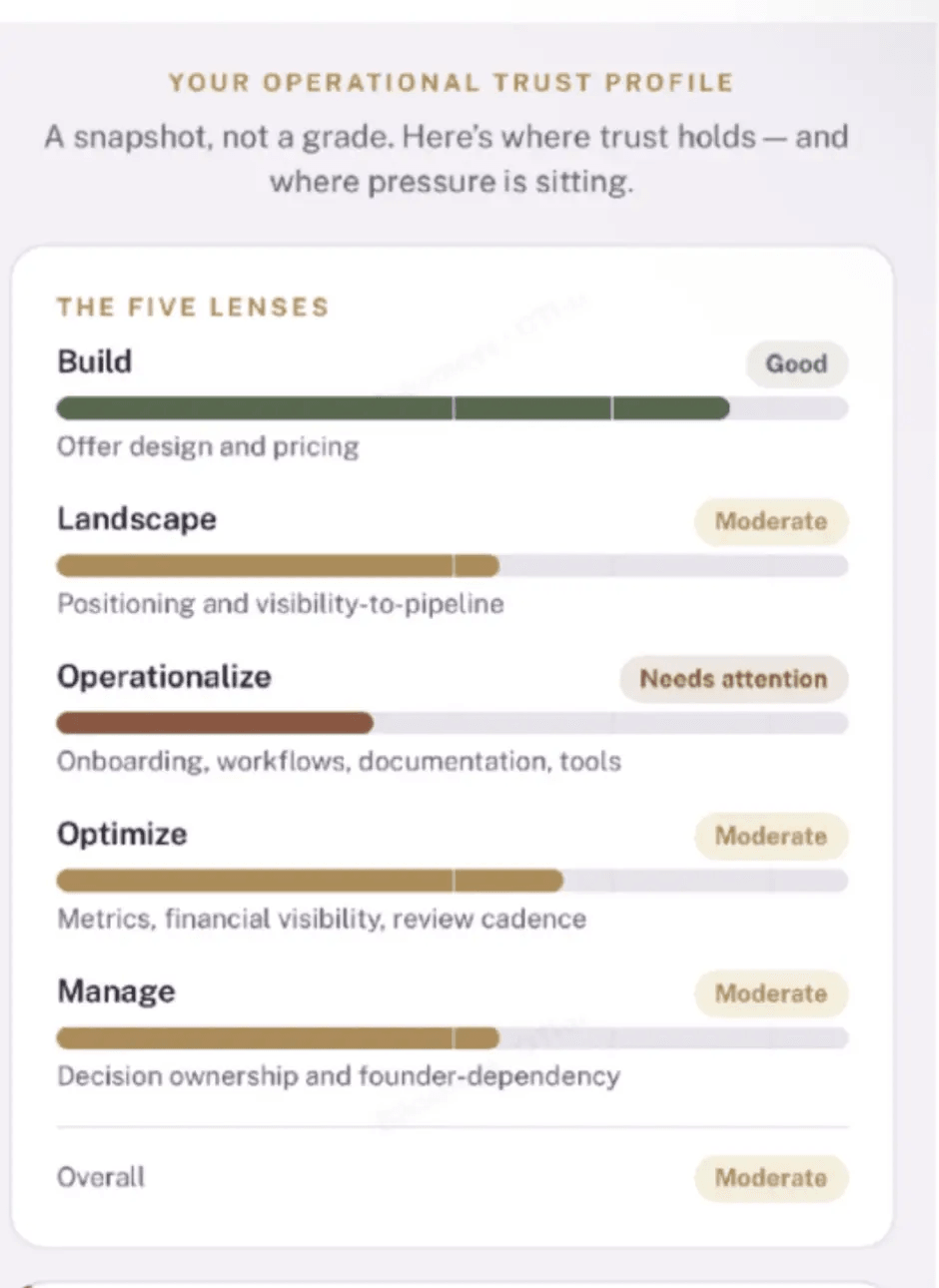
The trust underneath the operational issue
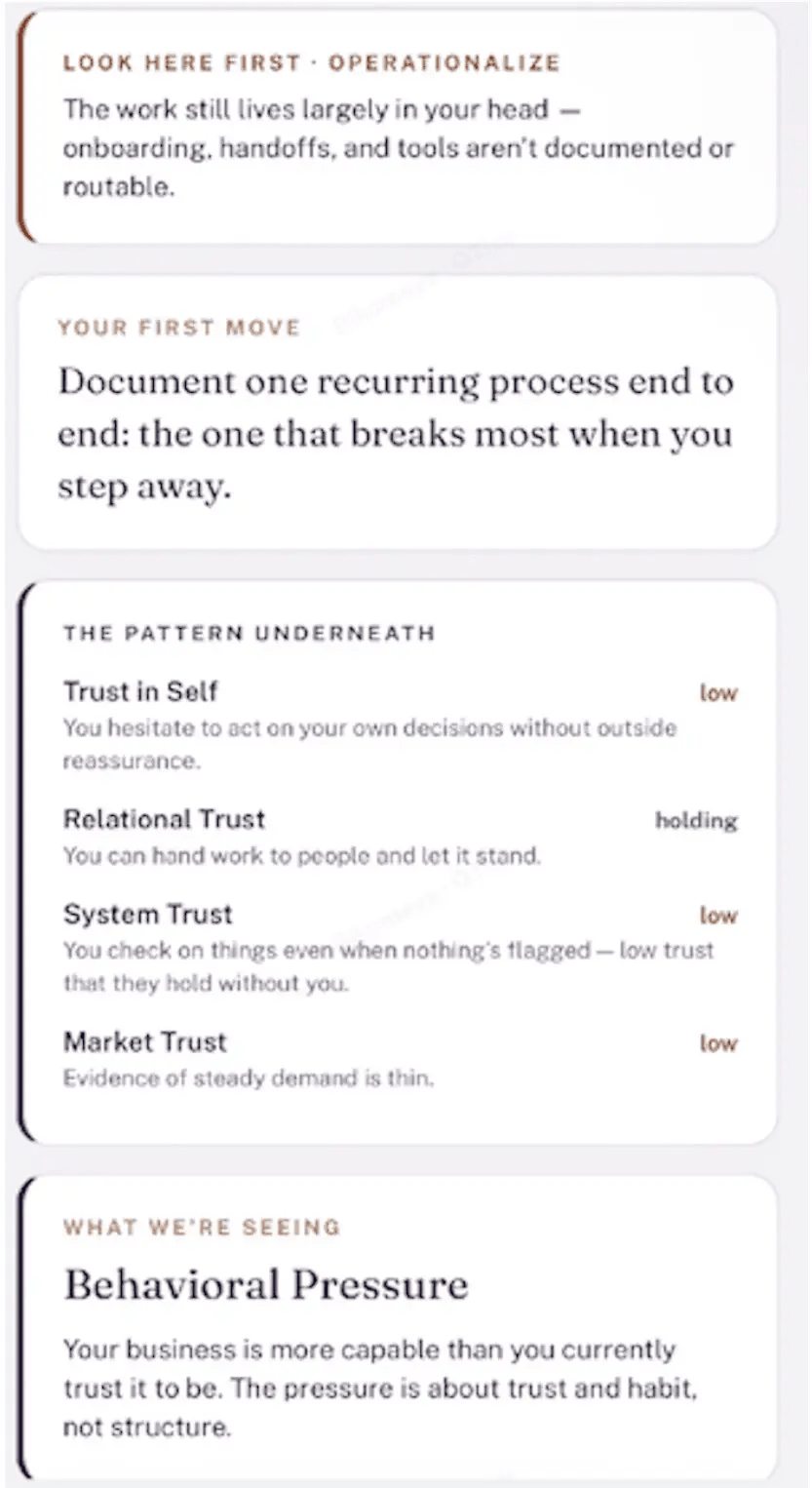
Operational pressure is rarely only a systems story. Under broken handoffs, constant checking, and founder dependency sits a question: what or who can hold the business without constant intervention?
Trust in self
Can the founder make a consequential decision and act on it, or does action stop while more reassurance is gathered?
Relational trust
Can work be handed to another person with clear expectations and real ownership, or does delegation create more supervision and rework?
System trust
Can a documented process run unless something is flagged, or does it still require constant checking to feel safe?
Market trust
Is there reliable evidence of demand, or does every slow week destabilize the operating plan?
These trust patterns help explain why the same workflow change works in one founder’s business and fails in another. The visible process is only one layer.
From the profile to the pressure type
The profile shows where to look. The lowest lens and the trust responses together identify the broad pressure pattern reflected in the result.
- Structural pressure: roles, handoffs, ownership, or workflows are missing or regularly breaking.
- Behavioral pressure: the same responses recreate the problem after new tools or processes are introduced.
- Strategic pressure: offers, clients, projects, or priorities pull the business away from the model it can support.
- Tech or clarity pressure: the business has tools and inputs but no dependable way to read the numbers or know what needs attention.
- Capacity or founder-dependency pressure: decisions, approvals, and delivery still route back through the founder.
Naming the pressure matters because each type requires a different decision. A capacity problem does not resolve through better delegation. An unclear ownership problem does not resolve through another hire. A strategic problem does not resolve through a faster workflow.
Who should take the OTI, and who should not
The OTI is for solopreneurs and lean service businesses with an offer, clients, revenue, and recurring delivery already in motion. Many are operating around $50K–$500K+ in annual revenue, but the real requirement is enough operating history to answer from evidence rather than aspiration.
If you are still choosing your first offer or have not begun serving clients, the OTI is too early. If you need to diagnose a department, nonprofit, school district, corporation, or established team, skip the OTI and use NJW’s operational audit process instead.
Choose the path that matches the business.
Founders can take the OTI and bring the result into the Operational Pressure Bootcamp™ or a Pressure Relief Call. Leaders diagnosing a larger operation should begin with the audit path.

Writing about what a business reveals before its founder asks it to carry more.